
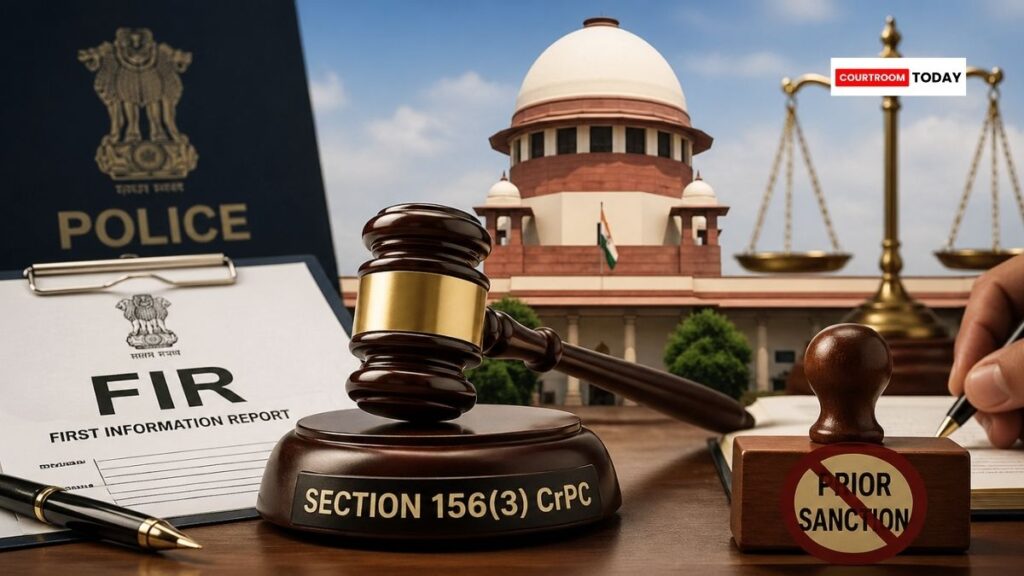
The Supreme Court, in Brinda Karat v. State of NCT of Delhi, has clarified that a Magistrate can direct registration of an FIR under Section 156(3) of the Code of Criminal Procedure without requiring prior sanction from the government.
The case arose from a petition filed by Brinda Karat, who challenged the refusal to register an FIR against certain political leaders over alleged hate speeches before the 2020 Delhi riots. The Magistrate and the Delhi High Court had earlier held that prior sanction was necessary before such directions could be issued.
Rejecting this view, the Supreme Court explained that the requirement of sanction under Sections 196 and 197 CrPC applies only at the stage of taking cognizance by a court. It does not apply at the earlier stage when a Magistrate orders investigation or registration of an FIR under Section 156(3).
The bench comprising Justices Vikram Nath and Sandeep Mehta emphasised the distinction between pre-cognizance and post-cognizance stages in criminal proceedings. The Court held that directing the police to register an FIR or conduct an investigation is part of the pre-cognizance stage, where prior sanction is not required.
While partly allowing the petition, the Court set aside the Delhi High Court’s observation that prior sanction was mandatory before directing an FIR under Section 156(3). However, it did not issue broader directions regarding the creation of new laws on hate speech, stating that the existing legal framework is sufficient to deal with such offences.
The judgement reaffirmed that the police are duty-bound to register an FIR when information discloses a cognizable offence. This principle was earlier established in the landmark Lalita Kumari v. Government of Uttar Pradesh case.
The Court also highlighted the remedies available to individuals when the police fail to register an FIR. An aggrieved person can approach the Superintendent of Police under Section 154(3) CrPC and, if necessary, seek directions from a Magistrate under Section 156(3). Alternatively, a complaint can be filed directly before a Magistrate under Section 200 CrPC.
Importantly, the Court observed that this statutory framework provides a complete mechanism to address grievances related to non-registration of FIRs. It further noted that constitutional remedies under Articles 32 and 226 also remain available.
The judgement underscores the importance of proper implementation of existing laws rather than creating new provisions. It reinforces the role of Magistrates in ensuring access to justice at the initial stages of criminal proceedings.
——————————————–
Have a case update, article, or deal to share? Courtroom Today welcomes contributions from lawyers, law firms, and legal professionals. Write to contact@courtroomtoday.com