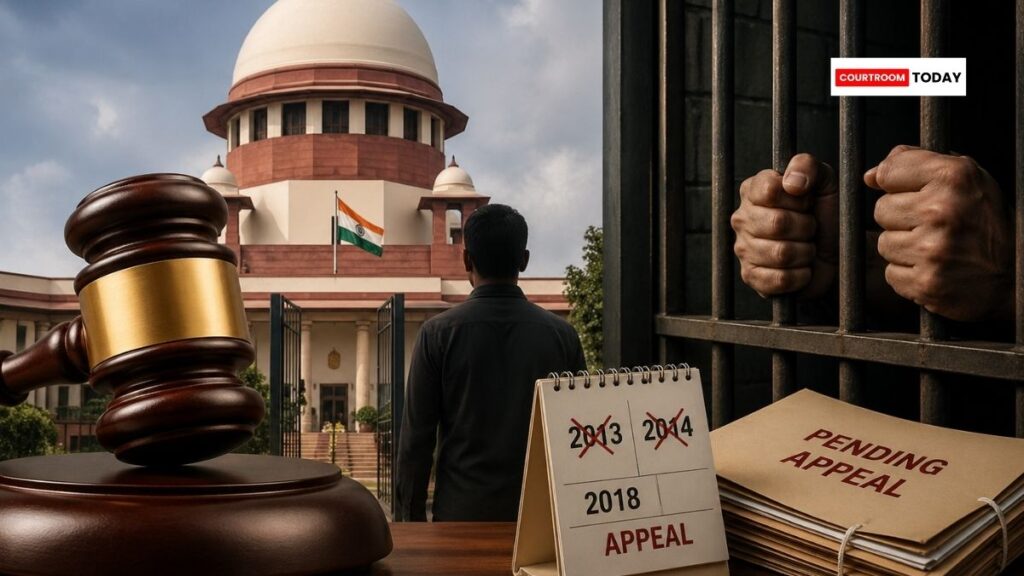
In Shivendra versus The State of Madhya Pradesh, the Supreme Court suspended the sentence of a murder convict, citing prolonged delay in hearing his appeal. The Court noted that the Madhya Pradesh High Court is still dealing with older criminal appeals from 2013 and 2014.
The case involved a man convicted by a Trial Court for the murder of his wife and sentenced to life imprisonment. He challenged the conviction in 2018 before the High Court, but his appeal has remained pending since then.
During this period, the petitioner has already spent eight years in custody. He had earlier sought suspension of sentence under Section 389(1) of the Code of Criminal Procedure, but the High Court rejected his request.
The matter then reached the Supreme Court, where a bench of Justice J.B. Pardiwala and Justice K.V. Viswanathan examined the situation. The Court took note of the backlog in the High Court and the delay in listing newer appeals for hearing.
The bench observed that since appeals from 2013 and 2014 are currently being heard, the petitioner’s 2018 appeal is unlikely to be taken up anytime soon. The Court highlighted that by the time the appeal is heard, the petitioner could spend another three to four years in prison.
Considering these circumstances, the Court decided to exercise its discretion in favour of the petitioner. It emphasised that prolonged incarceration during the pendency of an appeal can be a relevant factor in granting relief.
Accordingly, the Supreme Court ordered that the life sentence imposed by the Trial Court would remain suspended. The petitioner was directed to be released on bail until the final disposal of his appeal, subject to conditions set by the Trial Court.
At the same time, the Court’s approach stands in contrast with an earlier ruling in Shivani Tyagi Versus State of U.P. & Anr., where it was held that delay alone should not be the sole ground for suspending sentence in serious offences like murder.
The present decision reflects a balance between the gravity of the offence and the practical realities of judicial delays. It underlines that exceptional circumstances, such as long incarceration without final hearing, may justify interim relief.
——————————————–
Have a case update, article, or deal to share? Courtroom Today welcomes contributions from lawyers, law firms, and legal professionals. Write to contact@courtroomtoday.com