We are all equal as beings, but society often judges a person’s ability just by how they look. For a time, people with disabilities were seen through an old medical model. This model was very wrong. It was linked to ideas like eugenics, which thought people were only valuable if they were physically perfect. Now, international human rights frameworks like the United Nations Convention on the Rights of Persons with Disabilities (UNCRPD) have changed this view. The World Health Organisation says disability is not a medical problem, but also about the barriers in the environment that stop people with disabilities from fully participating in society. In India we have agreed to this understanding, but in reality, our system is not fair. The biggest problem with disability rights in India today is that we need to review and change our disability reservation system. This system is facing allegations of certifications and does not consider invisible disabilities.
The laws in India that protect disability rights are strong. Come from the Constitution. Articles 14, 15, 16, and 21 say everyone is equal and has the right to life with dignity. Article 41 says the government should help people with disabilities to work and get an education. The Rights of Persons with Disabilities (RPwD) Act, 2016, was a step forward. It matched the law with the UNCRPD and included more types of disabilities. 21 Instead of just 7. This was good for disabilities like neurodivergent conditions, mental health disorders and blood disorders. However, this progress has also created an administrative problem. The 4% reservation in government jobs and educational institutions was meant to help people with disabilities. Now there are controversies about fake medical certificates being used to get these reserved spots. This is unfair. Takes opportunities away from those who really need them.
There’s also a problem with invisible disabilities competing for the same spots. There’s a debate about whether people with neurodivergent conditions and mental health issues should have their own separate spots. This way, they can have a chance without competing with people who have different types of disabilities. Besides the reservation issue, India still has a lot of ” apartheid.” With the Accessible India Campaign (Sugamya Bharat Abhiyan) most public and private buildings are not easy to access. This problem is also in the world. As India promotes “Digital India “, the lack of rules for websites is making it hard for people with visual and learning impairments to use the internet. In education, the National Education Policy (NEP 2020) wants schooling, but there a shortage of special educators. This makes some people wonder if separate schools might be better for students who need support.
To truly recognise the rights of Persons with Disabilities, we need to move beyond just making promises in laws. We need a transparent implementation. Bodies like the Department of Empowerment of Persons with Disabilities (DEPwD) and the Rehabilitation Council of India (RCI) must. Ensure that certifications are genuine. We must change our mindset to see that a person’s ability is not judged by how they look or behave. We should celebrate athletes who win Paralympic gold and make sure a law student can access a courtroom easily. The focus should be on removing barriers, not “fixing” the individual. With a fair reservation system, strict infrastructure checks and real digital inclusion, can India fulfil its promise to provide true equality for all its citizens?
Supporting Authority Disability Rights & Reservation in Public Employment
GENERAL MANAGER, SOUTH CENTRAL RAILWAY v. A.V. RANGACHARI & ORS.
(AIR 1962 SC 36) 5-Judge Bench S.K. Das, J.C. Shah, K.N. Wanchoo, M. Hidayatullah & A.K. Sarkar, JJ.
Brief Facts: The respondent, A.V. Rangachari, was a railway employee belonging to a Scheduled Caste. He challenged the Government of India’s reservation policy, which extended reservations not only to direct recruitment but also to promotions in railway services. The question arose whether the constitutional provisions permitting reservation under Article 16(4) were confined solely to appointments at the entry level or could also encompass promotions to higher posts in government service.
Issues
1. Whether the expression ‘appointments’ under Article 16(4) of the Constitution includes promotions to higher posts in government service.
2. Whether the State is competent to make reservations in favour of backward classes in matters of promotion.
Legal Reasoning: The Supreme Court interpreted Article 16(4) broadly, holding that the term ‘appointments’ is not limited to initial entry-level recruitment but encompasses the entire process of employment, including promotions. The Court reasoned that to restrict the provision only to initial appointments would frustrate the constitutional objective of ensuring adequate representation of backward classes at all levels of public service. The Court emphasised that the founding fathers intended for the State to be able to extend reservation benefits wherever adequate representation was lacking.
Decision of the Court: The Supreme Court upheld the validity of reservation in promotions, holding that Article 16(4) permits the State to provide reservations in promotion as well as in direct recruitment. The State’s power to make reservations was thus confirmed to extend to promotional posts in government service.
INDRA SAWHNEY & ORS. v. UNION OF INDIA & ORS.
(1992) Supp. 3 SCC 217 | AIR 1993 SC 477, 9-Judge Bench M.H. Kania CJ, M.N. Venkatachalaiah, S.R. Pandian, T.K. Thommen, A.M. Ahmadi, Kuldip Singh, P.B. Sawant, R.M. Sahai & B.P. Jeevan Reddy, JJ.
Brief Facts: Following the implementation of the Mandal Commission Report by the V.P. Singh Government in 1990, which recommended 27% reservation for Other Backward Classes (OBCs) in central government services, several writ petitions were filed challenging this decision. The petitioners, led by Indra Sawhney, contended that the reservation exceeded constitutionally permissible limits and violated the right to equality. The case also raised the issue of the ‘creamy layer’ concept, i.e., whether the more affluent members of backward classes should be excluded from reservation benefits.
Issues
1. Whether reservations under Article 16(4) can be extended to promotions in addition to direct appointments.
2. Whether the total quantum of reservations can exceed 50% of available posts.
3. Whether the concept of the ‘creamy layer’ should be applied to exclude the more advanced sections of backward classes.
4. Whether backward classes can be identified solely on the basis of caste.
5. Whether reservations can be made in favour of the economically backward among the forward classes.
Legal Reasoning: The nine-judge Constitution Bench by a majority of 6:3 overruled the Rangachari decision on the question of reservation in promotions, holding that Article 16(4) does not permit reservation in promotions and applies only to initial appointments. The Court laid down the famous ‘50% rule,’ holding that total reservations in any year cannot ordinarily exceed 50% of the vacancies. It also firmly established the ‘creamy layer’ doctrine, holding that the more advanced sections within OBCs who had attained a certain level of social, economic, and educational advancement must be excluded from reservation benefits. The Court rejected identification of backwardness on the basis of caste alone, requiring objective criteria. Importantly, the Court held that economic backwardness per se is not a ground for reservation under Article 16(4).
Decision of the Court: The Court upheld 27% reservation for OBCs subject to exclusion of the ‘creamy layer.’ It struck down the 10% reservation for economically backward forward classes as unconstitutional. The judgment is a landmark in that it capped reservations at 50% (with extraordinary exceptions), introduced the creamy layer exclusion, and restricted reservations in promotions – a position subsequently modified by constitutional amendment (77th Amendment, 1995).
M. NAGARAJ & ORS. v. UNION OF INDIA & ORS.
(2006) 8 SCC 212, 5-Judge Bench Y.K. Sabharwal CJ, K.G. Balakrishnan, S.H. Kapadia, C.K. Thakker & P.K. Balasubramanyan, JJ.
Brief Facts: The constitutional validity of the 77th, 81st, 82nd, and 85th Amendments to the Constitution was challenged. These amendments, among other things, inserted Article 16(4A) (reservation in promotion for SCs/STs), Article 16(4B) (carry-forward of unfilled SC/ST vacancies), and modified Article 335 to permit relaxation of efficiency standards for SC/ST promotions. The petitioners argued these amendments violated the basic structure of the Constitution by infringing the principle of equality and merit.
Issues
1. Whether the constitutional amendments introducing reservation in promotions for SCs and STs with consequential seniority violate the basic structure of the Constitution.
2. What are the preconditions that the State must satisfy before providing reservation in promotion?
3. Whether the 50% ceiling on reservations applies to promotion quotas as well.
Legal Reasoning: The Constitution Bench upheld the constitutional amendments as valid but read them down by imposing three mandatory preconditions that the State must satisfy before providing reservation in promotion: (i) the State must collect quantifiable data on the backwardness of the class; (ii) the State must demonstrate inadequacy of representation of that class in public employment; and (iii) the State must consider the overall administrative efficiency before providing such reservation. The Court held that these conditions are not just procedural but are substantive requirements to justify departure from the general rule of merit in promotion. The Court reaffirmed the 50% cap on total reservations and held that the right to reservation in promotion is not an absolute fundamental right but an enabling provision subject to satisfaction of these conditions.
Decision of the Court: The amendments were upheld as constitutionally valid, but the Court imposed a ‘triple test’ as a mandatory precondition: the State must demonstrate (1) backwardness of the concerned class, (2) inadequacy of representation, and (3) maintenance of overall administrative efficiency. This effectively meant that States cannot mechanically provide reservations in promotions without empirically establishing these three conditions through quantifiable data.
RAJIV KUMAR GUPTA & ORS. v. UNION OF INDIA & ORS.
(2016) 13 SCC 153, 2-Judge Bench, Madan B. Lokur & N.V. Ramana, JJ.
Brief Facts: The Union of India issued an Office Memorandum in 1997 extending reservation in promotion to Scheduled Castes and Scheduled Tribes in Group ‘A’ posts. The validity of this Memorandum and the conditions subject to which reservation in promotion may be granted were challenged. The dispute also involved the question of whether the three conditions laid down in M. Nagaraj, particularly the collection of quantifiable data on backwardness and inadequacy of representation, were mandatory prerequisites or merely guidelines.
Issues
1. Whether the collection of quantifiable data showing backwardness is a mandatory precondition before providing reservation in promotion to SCs and STs.
2. Whether SCs and STs can be presumed to be backward for the purposes of Article 16(4A) without fresh data collection.
3. Whether the conditions in M. Nagaraj apply equally to SCs and STs as to OBCs.
Legal Reasoning: The Division Bench noted a conflict in the interpretation of M. Nagaraj with respect to whether the ‘backwardness’ condition applies to SCs and STs. The Court referred the question of whether M. Nagaraj requires reconsideration by a larger bench, particularly noting that since SCs and STs are already identified by the President under Articles 341 and 342, requiring fresh proof of their backwardness may be unnecessary and burdensome. The Court distinguished between OBCs – whose backwardness must be independently verified – and SCs/STs, who are constitutionally recognised as the most backward communities.
Decision of the Court: The matter was referred to a larger Constitution Bench for re-examination of the correctness of M. Nagaraj’s application to SCs and STs, specifically on whether the precondition of collecting quantifiable data to establish backwardness is required when the legislature has already constitutionally identified SCs and STs as the most deserving of protection. This reference ultimately led to the Jarnail Singh judgment in 2018.
SIDDARAJU v. STATE OF KARNATAKA & ORS.
(2020) 15 SCC 265 | Civil Appeal No. 5094 of 2007, 2-Judge Bench, Madan B. Lokur & Deepak Gupta, JJ.
Brief Facts: The appellant, Siddaraju, was a government employee suffering from a physical disability (locomotor disability). He challenged the State of Karnataka’s refusal to extend him reservation benefits in promotion under the Persons with Disabilities (Equal Opportunities, Protection of Rights and Full Participation) Act, 1995 (since replaced by the RPwD Act, 2016). The State contended that the PwD Act, 1995 did not contemplate reservation in promotional posts and that such reservation was limited to initial appointments only.
Issues
1. Whether persons with disabilities are entitled to reservation in promotion under the Persons with Disabilities (Equal Opportunities, Protection of Rights and Full Participation) Act, 1995.
2. Whether Section 32 and 33 of the PwD Act, 1995, which provide for reservation in government establishments, extend to promotions in addition to direct appointments.
3. What is the nature and scope of the State’s obligation towards employees who acquire a disability during service?
Legal Reasoning: The Supreme Court took a purposive and rights-based approach to interpretation of the PwD Act, 1995, consistent with the principles underlying the UNCRPD ratified by India. The Court held that the object of the Act is to ensure equal opportunity and full participation of persons with disabilities in all aspects of public life, including career progression in public employment. The Court held that a narrow, technical reading of the Act to exclude promotions would defeat this purpose. The Court further observed that an employee who acquires a disability during service and is thereby compelled to work in an unsuitable post should not suffer career stagnation as a result of their disability.
Decision of the Court : The Supreme Court allowed the appeal, holding that reservation benefits under the PwD Act, 1995 extend to promotions as well and are not confined to initial appointments. The State was directed to grant the appellant the benefit of reservation in promotion. This judgment significantly strengthened the employment rights of persons with disabilities in public service and is a key precedent for the rights-based interpretation of disability legislation in India.
STATE OF KERALA & ORS. v. LEESAMMA JOSEPH
(2021) 7 SCC 580 | Civil Appeal No. 2902 of 2021, 2-Judge Bench D.Y. Chandrachud & B.V. Nagarathna, JJ.
Brief Facts: Leesamma Joseph, a government employee, was a person with a locomotor disability. She was denied the benefit of reservation in promotion under the PwD Act, 1995 by the State of Kerala, which argued that the reservation quota had already been filled and no separate vacancy existed for persons with disabilities at the promotional level. She further contended that the 3% reservation mandated under the PwD Act was to be computed on the total number of vacancies in the cadre strength and not merely on vacancies arising in a particular year.
Issues
1. Whether the 3% reservation for persons with disabilities under the PwD Act, 1995 (now 4% under the RPwD Act, 2016) is to be calculated on the basis of total cadre strength or only on the basis of vacancies arising each year.
2. Whether the reservation for persons with disabilities extends to promotional posts.
3. What is the appropriate method for computing the backlog of vacancies for persons with disabilities?
Legal Reasoning: The Supreme Court, through Justice D.Y. Chandrachud, delivered a landmark judgment adopting a transformative constitutional approach. The Court held that the reservation for persons with disabilities must be computed on the basis of total cadre strength and not merely on cyclical vacancies. This is because disability reservation is a distinct and separate strand of reservation, fundamentally different in nature from SC/ST/OBC reservations, which are linked to social and educational backwardness. The Court emphasised that disability is not determined by birth but may arise at any point in life, and therefore, the reservation must be structured to ensure that persons with disabilities have meaningful access to public employment across the entire cadre. The Court also reaffirmed the Siddaraju ruling that reservation applies to promotions. Justice Nagarathna wrote a concurring opinion stressing the need for a rights-based understanding of disability rooted in the social model.
Decision of the Court: The Supreme Court held that the 3% reservation under the PwD Act (now 4% under the RPwD Act, 2016) must be calculated on the total number of posts in the cadre strength and not on the number of vacancies arising in a given recruitment year. The State of Kerala’s appeal was dismissed and Leesamma Joseph was entitled to the benefit of reservation in promotion. This is one of the most significant disability rights judgments of the modern era and directly informs the implementation of the RPwD Act, 2016 in public employment.
At last, the goal is to ensure that people with disabilities can participate fully in public life. No administrative errors or strict interpretations of laws should hinder their basic rights. Reservation offers essential opportunities, not charity, and seeks to address past injustices.
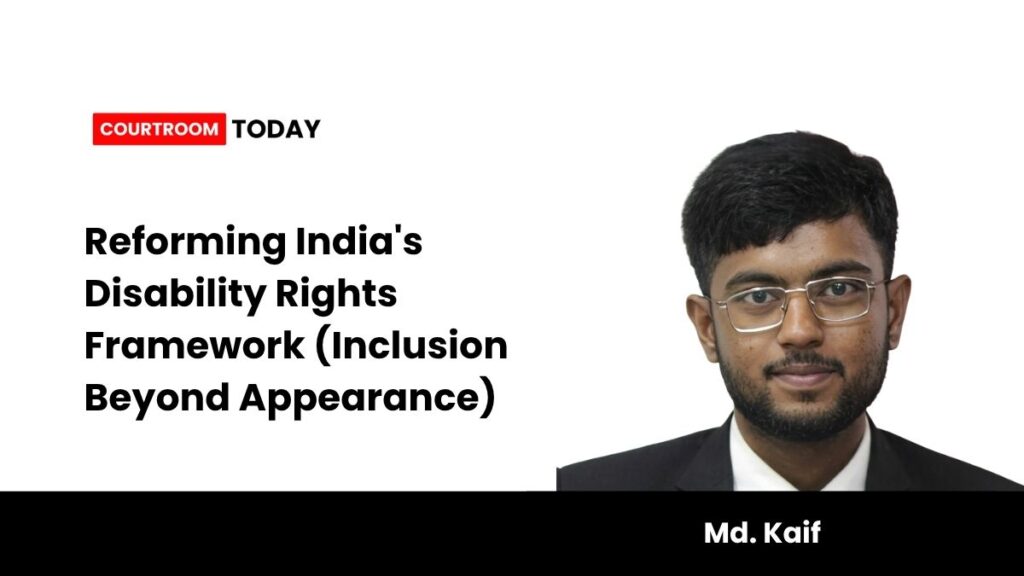
Author: Md. Kaif is a 3rd year law student at School of Law, Galgotias University.
——————————————–
Have a case update, article, or deal to share? Courtroom Today welcomes contributions from lawyers, law firms, and legal professionals. Write to contact@courtroomtoday.com