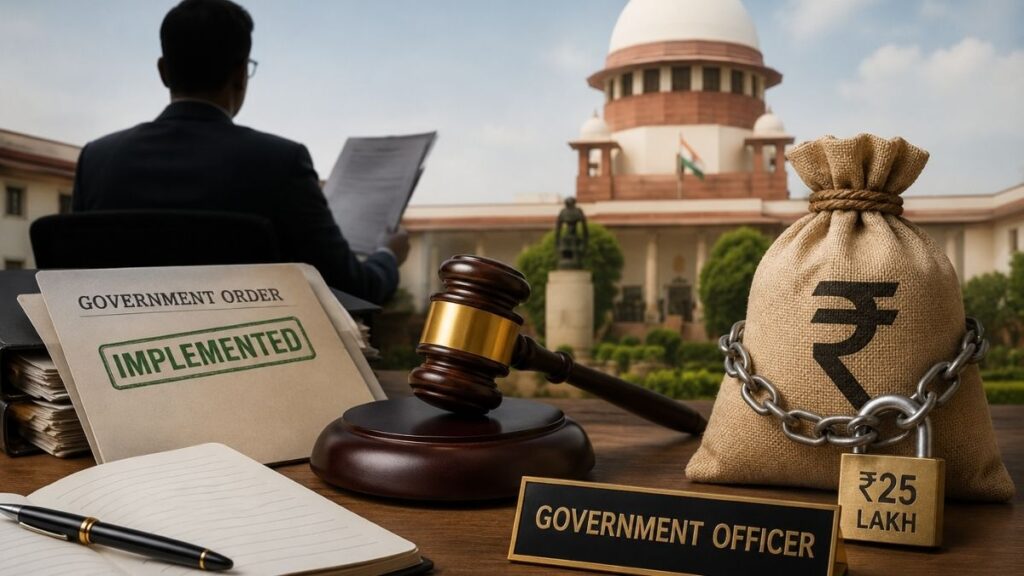
In C. Poorna Chandran v. The Government of Tamil Nadu & Ors., the Supreme Court set aside a ₹25 lakh penalty imposed personally on a Tamil Nadu government officer, observing that a public servant cannot be expected to act against an existing government policy while performing official duties.
A Bench of Justice Ahsanuddin Amanullah and Justice R. Mahadevan held that the officer had merely implemented a government order that was valid and operative at the relevant time. The Court also questioned the Tamil Nadu Government for failing to support its own officer when the High Court imposed the penalty.
The dispute arose from recruitment approvals in a private women’s college in Tamil Nadu. The former Director of Collegiate Education had refused to approve appointments beyond 11 Group-D posts because Government Order No. 219 dated October 24, 2013 restricted further recruitment.
The Madras High Court had earlier criticised the delay in approving appointments and payment of salaries to employees. While deciding the matter, the High Court imposed a total cost of ₹50 lakh, directing ₹25 lakh to be paid by the State and another ₹25 lakh to be recovered personally from the officer concerned.
Challenging this order before the Supreme Court, the appellant argued that he had only followed the prevailing government policy and had no authority to act contrary to the existing order.
Accepting this contention, the Supreme Court observed that the High Court failed to appreciate the position of a government servant functioning within the framework of official policy decisions.
“We are constrained to observe that the High Court should have been conscious of the fact that a government servant cannot be made to take a stand against the Government…”, the Court stated.
The Bench noted that the officer rejected approval only because the operative government order restricted recruitment beyond the sanctioned number of posts. The State later granted approval only after the government order itself had been quashed by the High Court.
The Court held that no personal liability could be imposed on the officer for actions taken in accordance with the law and policy existing at that time.
“Thus, in our considered opinion, no adverse liability can be fastened on the appellant, much less of imposition of heavy cost of Rs.25,00,000,” the Court observed.
The Supreme Court also expressed surprise over the conduct of the Tamil Nadu Government. It remarked that despite the officer implementing a valid government policy, the State remained silent and failed to defend him before the High Court.
“We are surprised as to why the State, who was the appellant before the High Court when the impugned order was passed, has chosen to remain silent and inactive despite an officer, who had acted as per law on the relevant day was not supported by the State Government by standing for him,” the Bench said.
The Court further extended relief to the State government as well, observing that the approvals were delayed because of a subsequent policy change after the earlier government order was struck down.
Allowing the appeal, the Supreme Court quashed the ₹25 lakh cost imposed on the officer and also set aside the cost imposed on the State. The Court reminded governments of their responsibility towards public funds, noting that such financial burdens ultimately fall upon taxpayers.
——————————————–
Have a case update, article, or deal to share? Courtroom Today welcomes contributions from lawyers, law firms, and legal professionals. Write to contact@courtroomtoday.com