
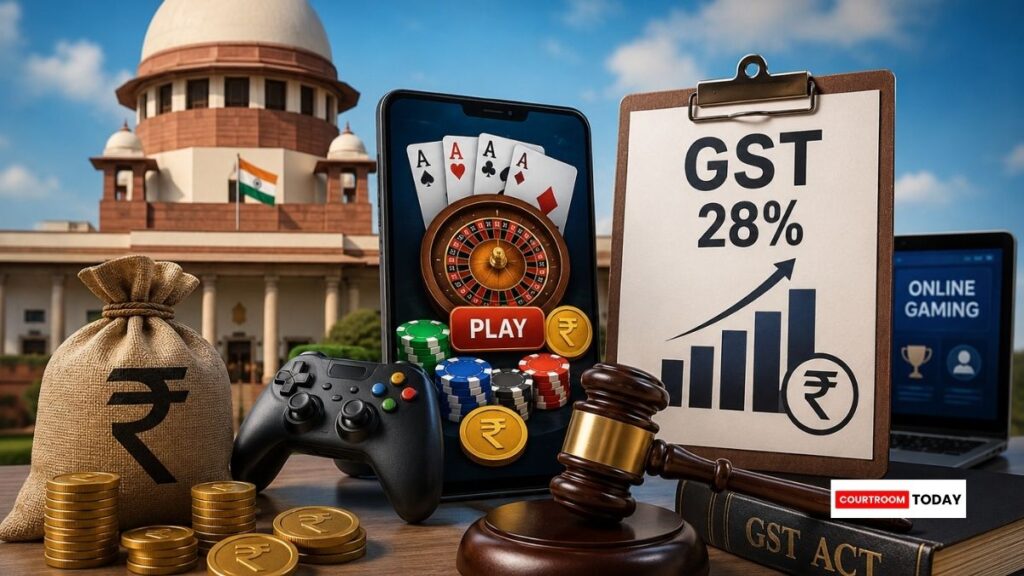
In Directorate of Revenue Intelligence v. Gameskraft, the Supreme Court has upheld the constitutional validity of the 28% GST levy on online gaming platforms where money is staked. The Court ruled that once players place bets involving real money on uncertain outcomes, the distinction between games of skill and games of chance becomes irrelevant for GST purposes.
A Bench of Justices JB Pardiwala and R Mahadevan delivered the judgement while deciding a batch of cases involving online gaming companies, fantasy sports operators and casinos. The Court also restored a ₹21,000 crore GST show-cause notice issued to online gaming company Gameskraft by the tax authorities.
The dispute centred around whether GST should be charged only on the platform fee earned by gaming companies or on the entire value of bets and contest entry amounts deposited by users. Gaming companies argued that taxing the full deposit amount at 28% was commercially excessive and legally unsustainable.
However, the Supreme Court rejected these arguments and held that online gaming operators are not merely intermediaries or facilitators. Instead, the Court said they supply actionable claims that are taxable under the GST framework.
The Court further observed that when money is staked on uncertain outcomes, even games involving skill take the character of betting and gambling for taxation purposes. Based on this reasoning, it upheld the validity of GST rules permitting taxation on the full face value of bets placed through online gaming platforms and casinos.
The judgement also overturned the Karnataka High Court decision that had earlier ruled in favour of Gameskraft. The High Court had held that rummy is predominantly a game of skill and that the company was not liable for GST in the manner alleged by the tax department.
The Supreme Court additionally held that the 2023 GST amendments imposing 28% tax on online gaming, casinos and horse racing were clarificatory in nature. This means the levy can apply retrospectively even for the period before October 1, 2023.
The ruling is expected to have major financial consequences for the online gaming industry. Tax demands against the sector were initially estimated at around ₹1.12 lakh crore, while later reports placed the possible exposure, including penalties and interest, at nearly ₹2.5 lakh crore.
The Court clarified that pending adjudication proceedings and show-cause notices against gaming companies would now be decided in accordance with this judgement. The final determination of individual liabilities, however, will still be made by the concerned GST authorities.
The decision may also influence ongoing legal challenges relating to restrictions and bans on real-money online gaming across various States in India. A detailed copy of the judgement is awaited
——————————————–
Have a case update, article, or deal to share? Courtroom Today welcomes contributions from lawyers, law firms, and legal professionals. Write to contact@courtroomtoday.com