
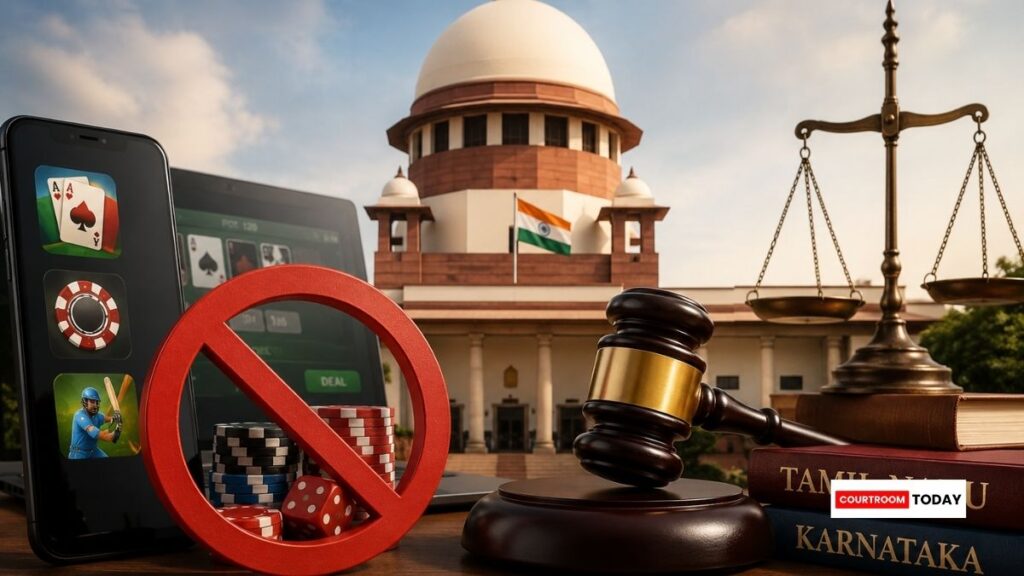
The Supreme Court in State of Tamil Nadu v Junglee has upheld the laws enacted by Tamil Nadu and Karnataka banning online games played for money or stakes. The Court ruled that there is no fundamental right to engage in betting and gambling activities, even when such games involve elements of skill like rummy, poker, and fantasy sports.
A Bench of Justice JB Pardiwala and Justice R Mahadevan set aside the earlier judgments of the Madras High Court and Karnataka High Court, both of which had struck down the State amendments regulating online gaming. The Supreme Court observed that betting and gambling fall under the category of “res extra commercium”, meaning activities outside the protection of trade and commerce rights under the Constitution.
The Court clarified that once money or wagering becomes part of a game, the distinction between skill and chance loses importance. It stated, “When the element of betting and gambling enters the picture, the nature of the game ceases to be of relevance.” The Bench further noted that staking money on uncertain outcomes creates serious concerns relating to addiction, financial distress, and social harm.
The judgment accepted the arguments raised by Tamil Nadu and Karnataka regarding public health and public order. The States had pointed to increasing cases of addiction, monetary losses, cheating, and suicides allegedly linked to online money gaming platforms. The Court held that States are constitutionally empowered to regulate or prohibit such activities in the larger public interest.
The dispute began after Tamil Nadu amended its gaming laws in 2021 through the Tamil Nadu Gaming and Police Laws (Amendment) Act. The amendment expanded the definition of gaming and prohibited wagering or betting in cyberspace. As a result, even games traditionally recognised as games of skill could attract criminal liability if played online for money.
Gaming companies challenged the law before the Madras High Court, relying on earlier Supreme Court decisions including Chamarbaugwala, K Satyanarayana, and KR Lakshmanan. They argued that games involving substantial skill are protected business activities under Article 19(1)(g) of the Constitution. The High Court had accepted this argument and struck down the amendment in 2021.
Karnataka later introduced similar amendments through the Karnataka Police (Amendment) Act, 2021. The law widened the definition of gaming to include online games involving wagering, betting, tokens, electronic transfers, and virtual currency. The Karnataka High Court also struck down the amendment in 2022, observing that merely shifting a game from physical to online mode did not change its character as a game of skill.
Both States challenged the High Court rulings before the Supreme Court. The apex court has now reversed those decisions and upheld the constitutional validity of the State laws. The ruling is expected to have a major impact on India’s online gaming industry and future State regulation of money-based gaming platforms.
——————————————–
Have a case update, article, or deal to share? Courtroom Today welcomes contributions from lawyers, law firms, and legal professionals. Write to contact@courtroomtoday.com