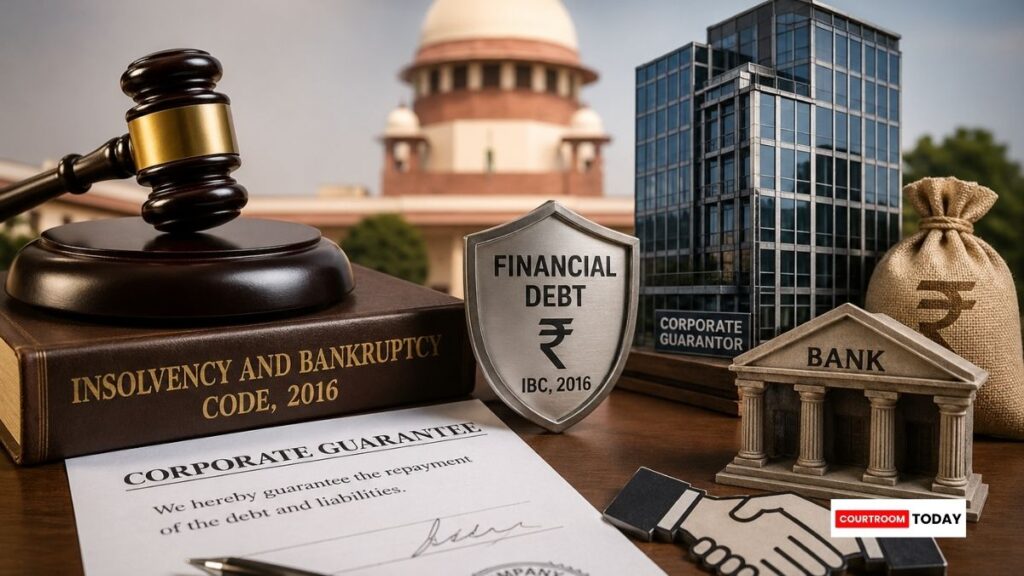
In STATE BANK OF INDIA & ORS. v. DOHA BANK Q.P.S.C. & ANR., the Supreme Court has clarified that a corporate guarantee can qualify as a “financial debt” under the Insolvency and Bankruptcy Code, 2016. The ruling addresses an important issue concerning creditor rights in insolvency proceedings.
The decision was delivered by a Bench comprising Justice Pamidighantam Sri Narasimha and Justice Alok Aradhe. The case arose from insolvency proceedings initiated against Reliance Infratel Ltd. (RITL), where a consortium of banks led by State Bank of India sought recognition of their claims.
The banks argued that RITL had issued corporate guarantees to secure loans taken by its group companies, including Reliance Communications and Reliance Telecom. When these loans turned non-performing assets, the banks invoked the guarantees and filed claims in the corporate insolvency resolution process (CIRP) against RITL.
However, both the National Company Law Tribunal (NCLT) and the National Company Law Appellate Tribunal (NCLAT) had rejected these claims. They declined to treat the guarantees as “financial debt,” thereby denying the banks the status of financial creditors in the insolvency proceedings.
The central issue before the Supreme Court was whether such corporate guarantees, given to secure loans involving the time value of money, fall within the definition of financial debt under Section 5(8) of the Code.
The Court answered this question in the affirmative. It held that a liability arising from a corporate guarantee clearly falls within the scope of financial debt. The judgment emphasised that guarantees provided for loans disbursed against consideration for the time value of money meet the essential requirements under the IBC.
The Court further observed that the liability of a guarantor is coextensive with that of the principal borrower. This means that once a guarantee is invoked, the guarantor becomes equally responsible for repayment, and such liability is legally enforceable.
Relying on established legal principles and previous rulings, including China Development Bank v. Doha Bank Q.P.S.C. & Ors., the Court reaffirmed that corporate guarantees cannot be excluded from the definition of financial debt when they secure borrowing arrangements.
Setting aside the decisions of the NCLT and NCLAT, the Supreme Court allowed the appeal. It recognised the appellant banks as financial creditors and directed inclusion of their claims in the CIRP of RITL.
This ruling strengthens the position of lenders in insolvency cases involving group companies and guarantees. It ensures that financial institutions are not deprived of their rights merely because the borrowing entity differs from the guarantor.
——————————————–
Have a case update, article, or deal to share? Courtroom Today welcomes contributions from lawyers, law firms, and legal professionals. Write to contact@courtroomtoday.com