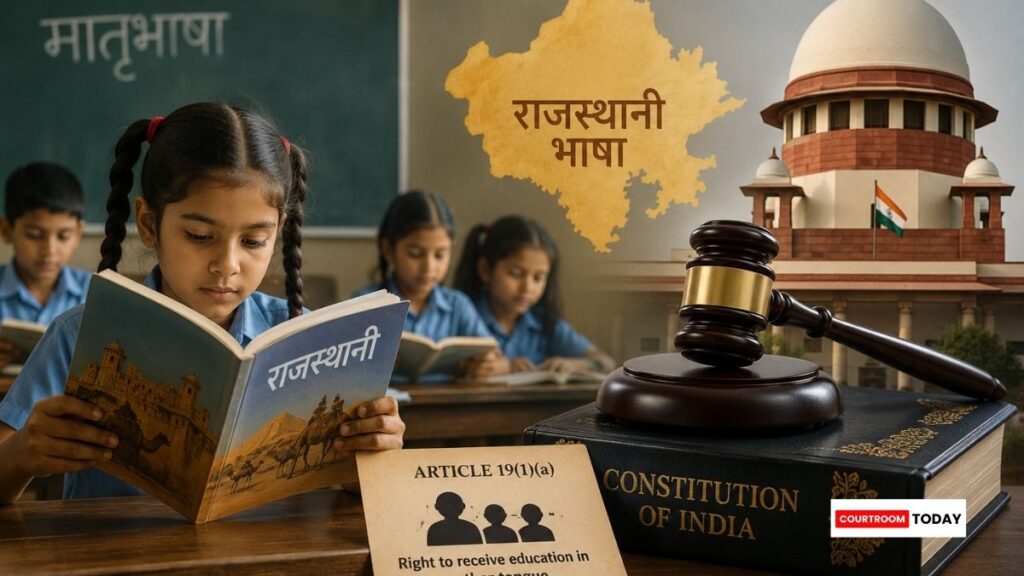
In Padam Mehta and Anr. v. The State of Rajasthan and Ors., the Supreme Court has observed that a child’s right to receive education in their mother tongue or language of choice forms part of the fundamental right guaranteed under Article 19(1)(a) of the Constitution.
A Bench of Justice Vikram Nath and Justice Sandeep Mehta made the observation while directing the Rajasthan Government to introduce Rajasthani language as a subject in all government and private schools across the State. The Court also asked the State to facilitate the use of Rajasthani as a medium of instruction.
The Court said that freedom of speech and expression under Article 19(1)(a) is not limited to the ability to communicate. It also includes the right to receive and understand information in a meaningful manner. According to the Bench, this becomes especially important in the context of primary education.
“At a more fundamental level, the right to receive education in one’s mother language finds its normative basis in Article 19(1)(a) of the Constitution,” the Court observed.
The Bench further stated that education serves as the primary method of transmitting knowledge and, therefore, should be imparted in a language best understood by the child wherever possible. The Court noted that learning in the mother tongue strengthens conceptual clarity and improves cognitive engagement among children.
The judgment referred to the earlier Supreme Court decision in State of Karnataka v. Associated Management of English Medium Primary & Secondary Schools. In that case, the Court had recognised that Article 19(1)(a) gives children the freedom to choose the medium of instruction at the primary level.
The earlier ruling had also clarified that the State cannot force students to study in the mother tongue merely on the ground that such education may benefit them. The present Bench reiterated that the objective should always be genuine comprehension and meaningful access to education.
While examining the issue, the Supreme Court also criticised the Rajasthan Government for not taking adequate steps to implement policies supporting education in regional and mother languages. The Court observed that both statutory and policy frameworks already recognise the importance of mother tongue-based education.
It said the State’s continued inaction could potentially infringe the fundamental rights guaranteed under Part III of the Constitution. The Bench emphasised that children must receive education in a language that enables them to properly understand and process information.
The Court ultimately directed Rajasthan to formulate and implement measures for introducing Rajasthani language as a subject in schools across the State. It also asked authorities to ensure that the constitutional and policy objectives relating to mother tongue education are effectively implemented.
Senior Advocate Dr Manish Singhvi appeared for the petitioners along with Advocate-on-Record DK Devesh.
——————————————–
Have a case update, article, or deal to share? Courtroom Today welcomes contributions from lawyers, law firms, and legal professionals. Write to contact@courtroomtoday.com